

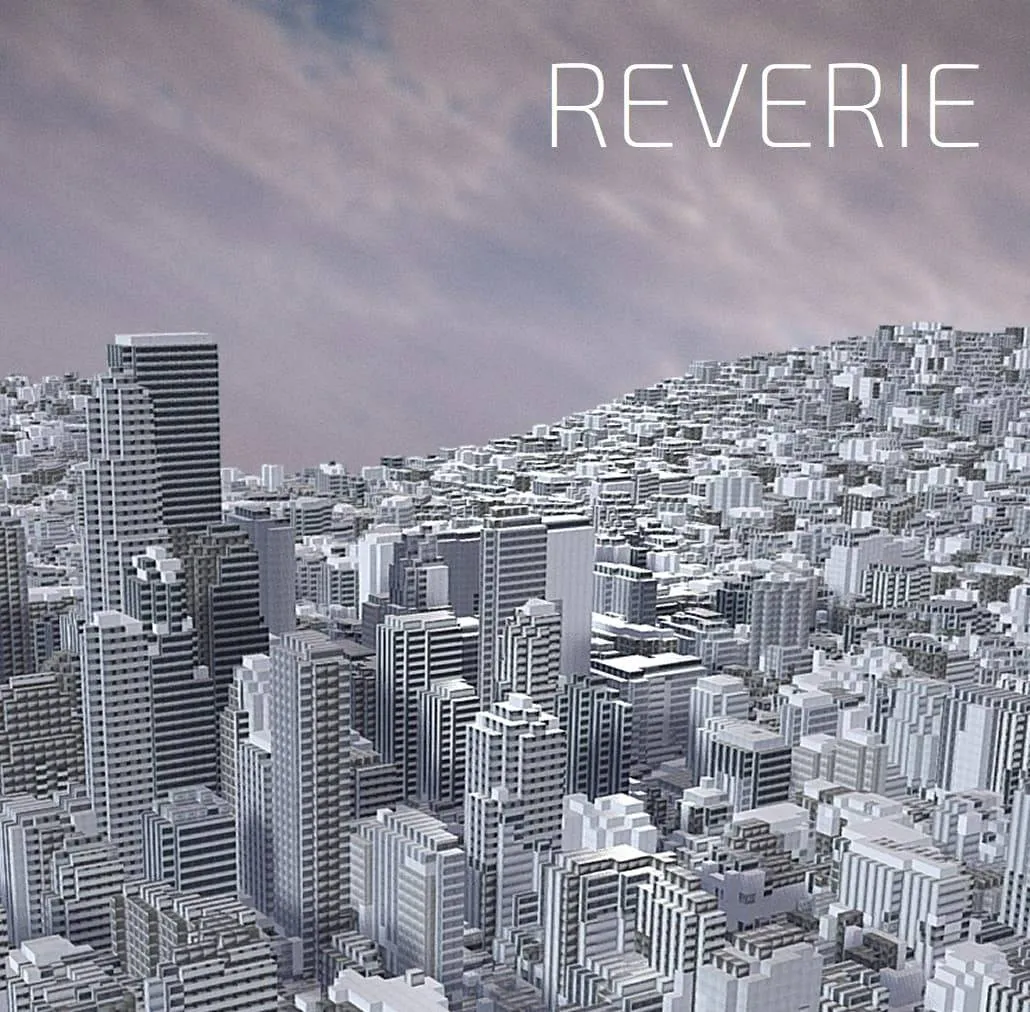
INTERLUDE
Your dream city was going to die. My actions were only prolonging the inevitable. That meant the window for my escape plan was closing fast, but I still felt reluctant to carry it out. Going from stalling the death of your city to accelerating it weighed on me, more so without any guarantee that it would wake me up.
More buildings were blinking out of existence behind me, even though I was keeping absolutely still. The rising rumble was enough to know it was picking up speed again. There was a resignation to it, as if Reverie sensed that your city had begun to slip from my mind.
I leaned into that resignation and spun around on my heels, which swelled the rumbling like it was obeying a volume dial. My escape plan would require little more effort than that. The frustrating part was that I needed to wake up to know it had worked, which struck me as someone else taking credit for my success.
I was feeling alienated from myself, knowing that I was actually still asleep. Maybe it was a coma by now. Maybe I was already awake and I was just an echo of my consciousness, trapped inside the Reverie console until someone turned it off. With a hint of irony, I would be that someone.
The sound of your dying city reminded me that I needed to hurry. My sense of time had become so dilated that I kept forgetting it could run out. Seeing no other option, I started walking forward while spinning in tight circles. The rumbling settled into an ear-splitting roar as I destroyed myself and everything around me.
CHAPTER 1
I wake up from a dream that immediately fades into oblivion by the sour light of the screen in front of me. It mentions that the plane will touch down at Heathrow in a little over an hour. I sigh and figure that’s not enough time to start another activity. At least I managed some sleep, though I don’t feel particularly rested or comfortable.
Unable to afford the surcharge for reserving a seat, I find myself wedged against one of the portside windows, my arms pressed into my sides and my knees just shy of touching my chin. To drive the point home, my seatmate decides to spread their legs a little further. The enduring feeling of being trapped flashes back a vague sense of what my dream was about, but it vanishes again just as quickly. I tend to have trouble remembering my dreams at the best of times.
Staring at the flat expanse of the Atlantic outside my window, I start contemplating other things I resent about air travel. A moment’s clarity dismisses all headaches as I consider that I’m only an hour away from seeing you again.
I had first travelled to London three months ago for a contract position that included a stretch of on-site work. Videogame development is mostly content with freelancers operating remotely, but the final production milestones of big-budget titles routinely involve 80-hour work weeks in a process aptly referred to as crunch. Major publishers like to fly freelancers in for a more closely managed workflow during crunch time.
Last year, my portfolio as a level designer had caught the eye of a producer working on a reboot of the Neocortex franchise. I was willing to swallow the on-site clause in the contract for an opportunity to work on the series that had inspired me to pursue a career in game design.
After nine months of creating levels for the Neocortex reboot and remotely communicating with the development team from my Toronto flatshare, I was gearing up for my flight to London to participate in the crunch. One week before my scheduled departure, I received word that the private dorm arranged for my stay had been replaced with a cot next to the desk I would be assigned. Sleeping in the office is considered standard practice during crunch, but all lingering notions of it being voluntary were now swept away.
The accommodation downgrade applied to all freelancers being flown in, and the consensus in our group chat was that the publisher had never budgeted for dorms to begin with. They hadn’t even planned on letting us know until after we had landed. They were forced to tell us when one of the developers working in the London office posted about the cots being placed.
This complicated matters, as I have severe social anxiety and was counting on my own space between workdays to decompress and recharge. Determined to see the development of Neocortex through to the end, I consented to having an anti-anxiety neuroid implanted.
Advances in brain-computer interfaces and injectable electronics have yielded the neuroid’s current design, which consists of a network of nanoprinted electrodes that can read and stimulate neural activity in the brain. The name is a portmanteau derived from the implant’s delivery method, which involves coating the individual electrodes in synthetic proteins and dispersing them in saline. This results in a neural colloid, a mixture of solid particles into a suspension liquid that can be injected anywhere in the body. The electrodes then migrate to the brain and nestle there.
Ranging from haptic feedback, prosthetic limb control, and neural imaging to the diagnosis and treatment of neurological disorders, neuroids have become synonymous with everything that brain implants and neurostimulation have already accomplished in the public eye. There are even neuroids configured to positively identify individuals based on unique patterns in their brain waves, an application referred to as neurometrics and touted as impervious to biotheft.
When paired with AR glasses or contacts, neuroids are well on their way to replacing smartphones as mobile computing devices. Just as smartphones had shifted computers from devices located in a specific place to devices you always have with you, neuroids are now shifting them from devices you have to devices you are.
Most neuroids produce passive effects, but it’s common to catch people with a thousand-yard stare, eyes almost imperceptibly scanning, hands twitching at interfaces visible only to them, projected into thin air or onto the nearest surface. I’m still carrying a smartphone in my pocket, and my seatmate is feverishly typing on their thighs.
Neuroids were far from an unknown quantity to me, but working on the Neocortex reboot had gotten me properly acquainted. All previous entries in the cyberpunk series empowered players with special abilities that were couched in accurate science, such as biomechanical prosthetics or nanotech infusions. For the abilities in the new Neocortex game, the designers had chosen neuroid technology as the foundation.
They had devised all sorts of fantastical neuroids that players could use to overcome enemies and obstacles, including mind control, remote aneurysm triggers, and even the ability to manipulate subjective time. Whether I wanted to or not, I learned about the science of neuroids by exhaustively reading the in-game text logs during playtests.
I didn’t share in the general apprehension regarding the invasive properties of neuroids, though I did find myself wary of their permanence. The individual electrodes of a neuroid are impossible to remove once they have nestled in brain tissue via their protein coatings. The coatings also suppress any adverse immune response, but there are stubborn concerns regarding a neuroid’s long-term biocompatibility.
In the end, I was convinced by a friend who had a neuroid implanted to treat their attention deficit disorder. It was their description of the sheer immediacy of a neuroid’s therapeutic benefits that sealed the deal, given only a week’s time before my flight. With pinpointed brain region targeting and individually tailored neurostimulation frequencies, finding the right treatment is no longer a question of arduous trial-and-error.
As advertised, the effects of my neuroid were nearly instantaneous once it was properly calibrated. Though I remained aware of the powerfully intrusive thoughts attached to my social insecurities and fears of rejection, I suddenly felt as if buying into those thoughts was optional rather than inevitable.
That carried me through the weeks of crunch that wrapped up development on Neocortex, but only in the following months, when I fell back into my rhythm, did I fully appreciate how the change was more profound than a temporary reprieve. It felt like a whole new outlook.
And just so, a neuroid’s permanence became its greatest asset.
As the pilot announces the plane’s descent towards Heathrow, the screen in front of me lights up with a biosecurity form. Most of the information is already filled out, but one of the empty fields requests a list of all implanted neuroids. I tick a single box for medical and take note of the other options, which include cognitive, recreational, and military. My seatmate hesitantly declares more than a dozen neuroids, unsure of how many they’ve implanted so far.
After disembarking, I make my way through the airport terminal. As I approach the bottleneck of immigration, I notice my seatmate heading for another queue that’s moving a lot faster than mine. A sign above the booth at the far end informs me that it’s an express checkout for people with neurometric implants. It hadn’t been there three months ago.
While shuffling forward, my phone finds a local network it can handshake with and chimes a series of message alerts. One of them is a selfie of you, smiling and pointing to the arrivals sign visible above your head. It almost makes me wish I was equipped to join the neurometric queue.
When I reach the immigration officer, someone who has the authority to decide whether I’m worthy of entering an entire country, I’m struck with feelings of guilt and fear. In the time it takes me to bend down and face the retinal scanner, I’m able to evaluate those feelings and dismiss them as hyperbole. There is no physical sensation to this process, but I have come to recognise exactly when my anti-anxiety neuroid intervenes to reassure me. Or, more accurately, when it gives me the clarity to reassure myself.
After I present my retina, the immigration officer glances at the data that starts spooling just over my shoulder and waves me on without any questions. I go through the same thought process for the biosecurity full-body scanner, with my neuroid helping me trust the updated vaccination screeners and temperature readings taken on the plane.
After I retrieve my backpack from the luggage claim, I follow the directions to the exit and notice that my neuroid just pulsed again. I take a moment to find the thing I should be worrying about, but then I remember that anxiety and excitement produce many of the same neurological responses, which my neuroid is now suppressing while still allowing me to appreciate the difference between the two feelings.
I round a corner and catch sight of the arrivals sign from your selfie. I eagerly scan the crowd and finally see you. Your smile betrays that you spotted me first. As you walk up and throw your arms around me for our second kiss, your voice cuts out the din of the crowd.
“Hi cutie!”
CHAPTER 2
I wake up to an unfamiliar ceiling light. When I look over to the other side of the bed, I see a familiar head of hair out from under the sheets. I prop myself up on one arm and look at you for a while, taking in the lines of your profile, the texture of your hair, the rhythm of your breathing.
“Are you watching me in my sleep?” you say through a sudden smile, snapping your head around to look at me. I nod with mock exaggeration, and then you scoot into my arms. “Take a closer look, you big weirdo.” I comply by kissing your neck.
It occurs to me in that moment that I hadn’t sensed the pulse of my anti-anxiety neuroid when you caught me staring. I was immediately confident that you weren’t genuinely upset, so no reassurance was needed. If I ever felt at ease around you purely by the grace of my neuroid, that no longer seems to be the case.
“So if you hadn’t come here, your name would have been left out of the Neocortex credits?” you asked.
I nodded. “They only add your name if you’re present when development wraps. It’s common fine print in big publisher contracts: make it to the finish line or your work won’t be acknowledged. You can’t even list the credit in your portfolio. So when word came down that it was sleeping in the office all the way through, I decided to get the neuroid.”
You made a disapproving face. I felt my cheeks flush, but then I decided your reaction was aimed at the toxic industry standard, not my participation in it.
“It’s also cheaper to fly in freelancers than it is to recruit locally because overseas workers aren’t subject to overtime laws here, and keeping everyone in the office 24/7 is great for all kinds of workplace monitoring systems.”
I was about to follow up with my standard diatribe about how neuroids are being used for mass neurosurveillance and behavioural modification, but then I got afraid that I was talking too much. A moment’s clarity suggested I only felt that way because I wasn’t accustomed to being this talkative with someone I’d only just met. I chased that thought and realised this was the longest I had spent time with anyone without immediately wanting to be by myself.
“You’re doing it again,” you said while looking away.
Evidently I was staring at you with a big grin on my face. I apologised and explained that it was my neuroid giving me pause to take stock of my thoughts. I could have just told you I really liked you, but the mere notion of doing that tensed me up so hard that it caught my neuroid off guard, taking longer to defuse my anxiety response.
By virtue of your own anti-anxiety neuroid, you understood where I was coming from. It turned out that we had both developed an acute sense for when our neuroids pulsed. Apparently it’s a more common awareness than I thought.
A new generation of leadership is pulling Venezuela out of the hole dug by decades of Chavismo, putting an end to the worst humanitarian crisis the country has endured. Prompted by your parents who remain in Caracas, you had emigrated to London five years ago, when Venezuela was at its lowest point and the mass exodus of people had reached nine million. After a few hard years as a care worker, you found your footing and started a job as a researcher for a data company in the healthcare industry.
That’s most of what you told me about yourself before and during our first date, but only later, when you felt more comfortable around me, did I learn about your experience in Venezuela. You laid out stories of violence committed with impunity, escalating from attempted muggings and tear gas becoming a daily nuisance to murdered neighbours and military crackdowns. What struck me at the time was how you told those stories almost as you would a series of funny anecdotes. “It’s the only way to deal with it, at least before my neuroid,” you said.
A Venezuelan friend who shared your pain had advised you to apply for an anti-anxiety neuroid. While a costly procedure under London’s privatised healthcare system, a medical neuroid implant is a one-and-done treatment that averages out relatively cheaply.
The calibration following your neuroid injection involved an hour of recall therapy to pinpoint the brain regions and neural pathways associated with your anxiety attacks. You described it as one of the worst hours of your life, with the process even bringing up several traumatic events that you had forgotten.
That it was worth the trouble became clear when you were walking home from the hospital and an ambulance bleated its siren as it drove by. The pulse of clarity that followed your initial shock was so abrupt, so contrary, that you’ve never forgotten what it felt like. Within a week, your back was less tense and you didn’t tire out so fast. You haven’t had an anxiety attack since.
The two things your neuroid couldn’t fix were that you didn’t miss your home any less, and that it had no way of stopping the dreams.
It wasn’t my intention to date while I was in London. After I arrived and settled in for the crunch, I set up a profile and started swiping more as a respite from the work than any real desire to meet someone. I still felt more comfortable being sociable through online chat than in real life, but as I started matching and the conversations took off, I found that my neuroid also bestowed a newfound romantic confidence.
I matched with you one week before development on Neocortex was set to wrap. If we were going to meet up, we had a window of a few hours on a Sunday morning before my scheduled return flight. We agreed on a breakfast date close to the airport.
The last week of crunch was gruelling, with endless bug fixes and last-minute changes forcing everyone to work day and night. Chatting with you and getting to know one another in anticipation of our date was one of the few things keeping my head above water.
After Neocortex went gold at the stroke of midnight on the longest Saturday of my life, nobody felt like celebrating. There was only sheer exhaustion. I managed a few hours of sleep before heading out to meet you at the breakfast place. The bus ride there left me so anxious that my neuroid almost took on a rhythmic pulse.
Then I met you. I saw your smile. I heard your laugh. I was sitting on the plane back home. Our date had flown by. I wanted to see you again, but it still took me a few days to work up the nerve to ask if you felt the same.
Seeing the development of Neocortex through to the end had been worth it, and not just because it had brought you into my life. The game was well-received and I was allowed to list my contributions in my portfolio, which opened up freelance contracts that just about covered a flight back to you after three months of work.
In that time, separated by five hours and five thousand kilometres, the thrill of our new and unexplored attraction grew into a sense of the familiar. There was no pretence, no dancing around the obvious. You didn’t just make me feel better about myself, you made me feel good about being part of a whole. It wasn’t long before I stopped questioning whether this new outlook was due to the comfort of our easy connection or the influence of my neuroid.
When I returned to London and you picked me up from the airport, our connection stretched to our physical intimacy. From holding hands on the bus to sleeping together on our first night, it all came naturally. It all felt right.
The next day, you tell me you love me. I say it right back.
My neuroid stays silent.
There’s a sense in any kind of long-distance relationship that all time spent together has to feel special and romantic. That pressure only lasted for the first few days of my time with you. Now we’re in your room, you wrapped up in a blanket and working on a new drawing, me sitting across from you and reading a book. Occasionally we throw a smile and a kiss at each other.
Three days before I fly back, we decide that I will move to London. It seems the most logical option, since my work isn’t tied to any location and I wouldn’t dream of taking you away from your support network. When I mention that I’m not looking forward to going home first, you stare into space for a bit and seem to come to a decision.
“You know, there is a way we can spend more time together right now,” you say. It’s a strange sentence to parse.
“Have you heard of Reverie?”
CHAPTER 3
I wake up and realise immediately that I’m still asleep. I have no idea how I got here, or what here is. The screenshots had shown sparse and blocky worlds, but actually being inside one of those worlds is nowhere near as underwhelming. The disorientation lasts a few seconds and then it hits me all over again.
I just woke up inside a dream.
While trying to figure out whether the dream is yours or mine, I’m startled by a robot behind me saying “Hi cutie!” When I whip around, the motion blur is so intense that it almost knocks me down. As the world sharpens again, I can see a figure there.
I squint to get a better look, but it’s a useless gesture since I have perfect visual acuity here. I’m using my mind to see, my nearsighted eyes are being bypassed. There’s also no depth of field, everything in view has the same focus to it.
The figure is definitely you, but also not. It looks like a rough photocopy, a digital approximation. “You’re a videogame character,” I say, realising that I sound like a robot too. You start to giggle, your voice alone making it difficult to keep a straight face. “My dream therapist warned me about that before our first session. It’s like, our inner voice doesn’t sound like our actual voice, it doesn’t sound like anything. Right now we’re thinking at each other and what we hear is the thought-to-speech parser.”
“So it’s actual telepathy,” I say through my own laughter.
Our speech is modulated for some semblance of intonation, but our laughter is picked up as a monotone hooting. The more we laugh, the more it cracks us up, and then we’re randomly yelling until it dissolves into a high-pitched squeal.
We’re in a dream, and it’s absolutely hilarious.
“Reverie. The stuff of dreams.” You rolled your eyes before turning the packet over. “Reverie is a revolutionary new application for neuroids that allows you to visit the lucid dream of another person and experience it together.”
“I think I’ve seen a headline about this. It’s not out yet, right? How do you have this?”
“It’s in the trial phase and I’m running a recruitment project to find eligible candidates. Turns out I fit the criteria because of my dream therapy, so the client offered to send me a test kit.”
“How does it work?”
You opened the packet, which contained two neuroid injectors on either side of a white, featureless box the size of my phone.
“We each inject one of these neuroids. They’re linked to this console, which has a local network and doesn’t interact with the neuroids unless it’s turned on. When we’re asleep, the console pings the neuroids, and then the person who starts to dream first brings the other into that dream so it can be shared.”
That sounded like the standard patter for the candidates in your Reverie recruitment project. “Okay, but how does it work? You’ve explained your dream therapy, but this seems two steps ahead of that. How does it put me in your dream?”
“In the documentation it said Reverie is actually based on neuroids for dream therapy, which is why I had to track down people who’ve done it before.”
I thought back to what you told me of your dream therapy as I lifted the Reverie console out of its foam insert. “So this thing interprets dreams from information gathered by the neuroids, and then generates those dreams as 3D spaces to explore while we’re asleep?”
“Yes, and that’s why it’s not exactly lucid dreaming. The 3D spaces are locked in once they’re created, more like a snapshot. It’s the same for dream therapy to prevent the dream from flying off the rails, like being in the middle of an intense session and suddenly you start to fly or make it rain blood. With Reverie, we don’t control the shared dream, but we do have full autonomy.”
I turned the console over in my hands, acutely aware of my neuroid pulsing again.
“Want to give it a go? We can spend more time together in our dreams, because time feels like it’s moving slower there.”
“I’m a bit iffy on how Reverie can take one person’s dream and feed it back to the other. Did the documentation say anything about that?”
“It was only mentioned once as a proprietary process. I think it’s a trade secret.”
“Mind if we dig into that a little first? I mean, I’m really touched that you want to try this with me, but if Reverie is in the trial phase, they’re still working out the bugs. That’s fine if we’re talking about a videogame in early access, but this is quality assurance for something that’s going in our brains forever.”
Once the novelty of our robot voices passes, we take a good look at each other. There is a strange, sinuous quality to your character model, which I had attributed to the excessive motion blur when I first noticed it. Now I can see it even when I’m keeping my head perfectly still. We’re also the same height, even though I’m a head taller than you.
“Your lazy eye is on the other side of your face,” you say.
“Really? Oh, your nose ring is on the other side too. Maybe our models are mirrored.”
I check my arms for identifying marks, but clearly I don’t have a mental roadmap of all my freckles and blemishes. I can’t tell my left arm from my right at all. I remember a birth mark on my side, but when I go to pull up my shirt, I can’t. It’s stuck to my body, though it does deform at my touch. The sensation is like tugging at fabric, but it feels weak and ineffective, like trying to run in a dream without moving ahead.
“Looks like we can’t take off our clothes.”
You laugh and throw back a look. “Is that seriously what you’re thinking of doing right now?”
“No, I just meant that… we are these clothes. They’re part of our character models. There’s nothing underneath.”
You start patting down your chest and sides, the motions again a strange blur. “It sure feels like I’m underneath.”
“That’s the haptic feedback making it seem like we can feel and touch our bodies, but I’m pretty sure we don’t have any bodies inside our outfits. I can try to explain it if you want?”
“Please! I kept asking my dream therapist about how all this digital stuff worked and they said they had no idea, and even if they did, it wouldn’t be relevant to the therapy process.”
I take a moment to find an analogy. “It’s kind of like that papercraft bunny in your room. It looks like a solid object, but it’s hollow on the inside, right? And it’s made up of tiny folds of paper? Same thing for our 3D models. We’re essentially wireframes made up of little triangles called polygons. More polygons means more detail, but also requires more processing power. I’m guessing there are some hard limits on that, considering this is all being generated in real-time.”
I bring my hand up to my face to check out my individual polygons, which seem to average out to about the size of my thumbnail. “Can you see the little polygons? They’re visible at the edges if you look real close.”
I stop to check again. I can only make out my polygons because they’re wriggling. I seem to be undulating, like there are tiny worms burrowing just beneath my skin.
“Okay, and why are my polygons moving exactly? Because that’s creepy,” you say to your own hand.
“No idea,” I shrug.
“Could it be related to this?” you ask while jumping and dancing around, which makes the strange blurring more obvious. Whenever you move, there seems to be a delay, like your polygons are struggling to keep up with you.
“Oh, I think I know what this is,” I realise. “So, if you want to animate a character model in a videogame, you would normally use a skeleton, with bones and joints that produce the movements for the model to follow. Right now, Reverie is rendering our models based on information stored in our brains. Or wait, what’s that called? Your body’s awareness of itself, like physically. There’s a word for it.”
“Proprioception?”
“Yes! Maybe Reverie is working off our proprioception to animate these models, which apparently doesn’t involve weighting the polygons against a skeleton. It’s animating our movements by manually keyframing our individual polygons, which causes them to…” I bounce my hand up and down. “Smear like this.”
“Nice, cheaping out on skeletons,” you say. “Not sure about proprioception though. That takes place after the fact, like a generalised impression of yourself. Maybe Reverie is based on neuroids for prosthetic limb control? Those have pattern recognition algorithms that can analyse brain activity during specific movements, use that to determine someone’s intent, and provide control for an artificial limb.”
“That definitely makes more sense.”
“It could also explain why we’re mirrored?” you add. “Not how the animations work, but that our models are based on visual information stored in our brains. If Reverie is digging around to find memories about what we look like, what better source than when we’re looking in a mirror? We put our faces right up to them, which provides the most visual detail.”
“And that would be the best way to get an objective idea of our appearances. I can’t imagine how Reverie would interpret what we think we look like.”
You hold your hand above your head and move it across to hover it over mine. “Well, it doesn’t seem to know how tall you really are. And who decided on these clothes? No offence, but jeans and a shirt is more your speed, cutie.”
If dreams are stories we tell ourselves, they’re non-linear stories with little to no regard for internal continuity. Early attempts at visually recording dreams couldn’t bring any meaningful order to that chaos.
The results were monochrome and soundless, and recording from only the visual parts of the brain divorced those snippets from their context. Artists and filmmakers experimenting with consumer-grade EEG readers were the first to depict their own dreams and those of others in a way that managed to evoke the real thing. They interpreted what was missing.
Reverie was born from a different, more indirect technique used to record dreams, which involved the analysis of neural patterns associated with visualising objects. Since these patterns remain consistent whether in a waking or dream state, it’s possible to catalogue them when people are awake and detect them when they’re asleep.
The advent of neuroids enabled a more precise analysis of neural patterns, even accounting for the different ways people visualise things. Neuroids also advanced the development of neurometrics, a practice equally predicated on finding unique and repeatable patterns in brain waves. These advances were fed back to dream imaging, finding more universal correlation patterns and eliminating the need for individual calibration save for a few outlying cases. Combining the data gleaned from neuroid scans with generative AIs resulted in dream videos with the distinct look of rotoscope animations.
When a French videogame company called Moodoo wrote a graphics engine that could interpret the neural data, it became possible to render dream worlds as 3D levels. Though limited to bare terrains with rudimentary props and no other actors, this graphics engine signalled the start of Moodoo’s development of Reverie.
At the same time, the Dream and Nightmare Laboratory in Montreal was working with neuroids to induce lucid dreams at will, which it succeeded in doing by stimulating specific parts of the prefrontal cortex during the dream state. While lucid dreaming remains a teachable skill, intracerebral neurostimulation is now a shortcut in the same way anti-anxiety neuroids are a shortcut to cognitive behavioural therapy, essentially speedrunning the required mental conditioning.
This led to neuroid-induced lucid dreams being used for various clinical applications, including treatments for depression and nightmare disorders. A range of recreational uses followed as well, with the experience of lucid dreaming soon rivalling virtual reality for its freeform immersion. Athletes are now able to boost their prowess by practising in their dreams, with sports organisations still debating what regulations to impose.
The final piece of the Reverie puzzle was added by DARPA, where researchers were already working with neuroids and behavioural neurostimulation to improve the effectiveness of military personnel. Initial attempts to build training programmes around lucid dreaming were accelerated when Moodoo created a more performant version of its graphics engine, allowing for dream levels to be generated live, while subjects are still dreaming. This laid the foundation for the type of dream therapy that you underwent.
Then the DARPA researchers discovered that, when they used an editor to change the dream levels as they were being generated, the subjects reported a direct awareness of those changes in their dreams. This feedback loop continues to defy explanation, with working theories relating it to a novel form of extended cognition or an unexplored function of mirror neurons. Ultimately, the researchers didn’t much care how it works, only that it works.
Further experiments revealed both the potential and the limitations of the strange feedback loop. By deleting a dream level in its entirety while it’s being generated and replacing it with a predesigned custom one, it’s possible to pull subjects into a dream that isn’t theirs. It only works with relatively simple levels, as anything approaching a certain threshold of complexity impacts performance and wakes the subject.
The first non-military application of DARPA’s discovery was a form of neurocarceration, achieved by placing convicts in a small dream level constructed to look like a prison cell. They can then be made to experience years instead of days in that cell because our minds tend to edit dreams so the mundane parts don’t register. With no stimuli beyond the featureless cell, that process has a quantifiable metric to it. Neurocarceration is currently undergoing trial runs in several countries dealing with overcrowded prisons. The CIA took it a step further and developed various types of cybertorture to circumvent the more widely understood ban on physically inflicting pain.
“And there it is,” I sighed after closing the last of the open tabs in my browser and putting away my phone. “Reverie comes from an accidentally discovered quirk of the brain that was immediately used to imprison and torture people inside their own heads. Because of course.”
“So it’s not a trade secret, but I can definitely see why they wouldn’t want to talk about this,” you said.
“How do you feel about it now?”
“I mean, it doesn’t really change anything, does it? A lot of technology is used for both noble things and evil shit.”
I stayed silent, unwilling to commit either way. Then you started gently tapping your index fingers together.
“Okay, I’m in.”
Our faces are our own, but our bodies aren’t. I’m assuming they’re stock models drawn from a selection of different body types, which would explain our similar heights and why we’re wearing clothes we don’t own.
Another giveaway is how our faces are mapped, which is reminiscent of early deepfake techniques to replace someone’s likeness in a video. As with the polygon warping, it’s more obvious in motion, making our faces appear as if they’re animated masks pulled over mannequin heads.
We also figured out that it’s impossible to hurt ourselves or each other. Falling down has the same impact as zero gravity in a bouncy castle and throwing a punch feels like it happens in slow motion. Repeatedly hurling ourselves to the floor leaves us in more fits of laughter.
“Hang on, let me try something else. Stay where you are.”
I start walking back while keeping my eyes on you and notice that your face shifts after about ten paces. It seems to lose definition from one footstep to the next. The rest of your body changes too, becoming more angular and making the polygon warping more apparent.
“There’s an LOD system!”
“What’s LOD?” you ask, though I can’t see your mouth moving because it’s no longer animated. I close the distance between us by a step and your model returns to its higher definition. Now that I have found the threshold, I can make the switch by rocking back and forth on my feet. From your high-definition face, I can tell you are noticing the same effect.
“It stands for level of detail. It switches to models with less complexity as you move farther away from them. You’re not paying as much attention if you’re that far away, so why keep all those polygons? It’s another way to go easy on the rendering pipeline.”
You walk right up to me. “That’s cool, but I think we’ve checked each other out enough. How about we figure out who started dreaming first?”
I look around and take in a strangely barren landscape. There are a few loosely scattered buildings and structures, but it’s mostly hillsides stretching out as far as the mind’s eye can see.
“Not much happening here.”
“Must be your dream then,” you smirk.
I laugh and push you to the ground, confident you’ll just bounce right back. When I return to the landscape, I immediately notice the change.
“You said the dream levels are locked in once they’re created, right?”
“Yeah?”
“That building over there is coming towards us.”
CHAPTER 4
I wake up inside a new dream, the last one we’re sharing before I’m flying back. Right away I’m confident that it’s finally one of yours. I tend to fall asleep sooner than you do, so every dream we’ve been pulled into so far has been mine.
I’m standing on a wide avenue with tower blocks on either side, arranged like rows of headstones. They rise to meet over my head, leaving a corrugated strip of light above as the only source of illumination. Up ahead I can see elevated roads running between the columns, sometimes even straight through them. If it wasn’t for the trees dotted around, the colour palette would be entirely grey. The whole thing looks like a brutalist fever dream.
I hear a robotic squeal to my right. Knowing full well that the scenery might change once I look away, I turn and catch you staring up at the buildings that surround us. Even before I close the distance between us and switch your character model to its high-def version, I can tell you’re smiling from ear to ear. When you spot me, you spread your arms wide and your smile even wider.
“This is it! This is my dream city!”
One of the routines we settled into after our first date was becoming each other’s dream journal. Mine tend to follow one of two running themes: either I’m trying to find my way to an obscure destination, or I’m back in school. Both amount to my social anxieties made manifest.
The dreams where I have to get somewhere involve navigating an impractical series of public transports, leaving from places I only vaguely recognise and constantly fearful of missing my next connection. My school dreams take place in labyrinthine facsimiles of the actual buildings, with far more stairwells and no indication of where any classes are being held. There’s always a part of my unconscious that’s puzzled as to why I’m back in school, and chasing that confusion is the closest I’ve come to lucid dreaming before Reverie.
You’re much better at remembering your dreams than I am, often recounting them in minute detail. You also have some recurring dreams of being back in school, but it skews towards university for you.
Mostly though, your dreams are weird. There’s the one where you had to retrieve someone from the clutches of hell in a canoe pushed along by wolves, or the one where you won a toast decorating competition by drawing a picture of Héctor Lavoe with jam and condensed milk. It got a hundred points.
Then you told me about your dream city. “The vibe is like Vienna, even though I’ve never been there. It looks like a mix of the streets of Caracas, the highways of Madrid, and Los Angeles in Blade Runner. It’s different every time I visit it, but I always recognise it, like I’m building it over time.”
The thought of being able to set foot in your dream city became another reason I was willing to try Reverie.
“I thought it was weird when you told me the Reverie dreams are static snapshots. Dreams aren’t feature-complete as soon as they come into being, they’re constructed as they’re discovered,” I said. We were both trying not to look at the building bearing down on us.
When we did look back, the building had changed again. Still the same, but not as tall as before, and again a great deal closer to us. Its interior also had more definition.
“Why is it doing that?” you asked.
“Hang on, I know this building! Look away again.”
“Okay, but if it gets any closer, I’m running.”
We stared into each other’s eyes, making faces to put ourselves at ease, and turned back to the building. Now it was unmistakable.
“It’s my grade school. That’s the gym there, next to the refectory and the round part, the stairwell. Why is it always the stairwells that are so vivid?”
You laughed. “That’s actually pretty cool! Now that you’re actively remembering your school and its layout, Reverie has more information to work with. And it only adds that extra detail when you’re not looking!”
“One more time? I’ll focus on remembering it while we’re not looking. And I’m sure it won’t come and crush us.”
I took a mental stroll through the building, making note of how the different hallways linked up and what the classrooms looked like. I also revisited a few moments of my time there, anchored by the different teachers and the one close friend I had throughout.
When we looked back, it was mostly all there. From the front gate with anticlimb spikes to the glass roofing of the library, my grade school loomed before us. You took my hand. “Should we check it out? Or does it need more detail?”
A strange blend of colours in one of the windows caught my eye. It took me a moment to realise it was a line of small coats hanging outside a classroom.
“No, I’d say it’s detailed enough.” I wanted to go inside, but something was holding me back.
“Are you okay?”
“Yeah, it’s just that… I spent six years in this place. And I’ve been back to my hometown since, I’ve walked past it, but that’s not the same.”
I gestured at the building in front of me while intently staring at it, afraid of how my thoughts would impact its appearance if I dared look away.
“This is my grade school not as it exists today, but as I remember it. Not only that, I can feel it. I mean, this building looks like how it made me feel back then. Does that make sense? Maybe it’s because I just made myself remember it really hard, I don’t know.”
I felt like I was going to cry. Unsure whether that would register on my character model, I tamped it down and smiled instead. Apparently it did register somehow, because you gave me a tight hug. “It makes perfect sense, cutie. We can go inside only if you want.”
We walked through the front gate and crossed the playground, where a few forgotten trees and benches materialised after looking the other way. Up ahead was the door to the assembly hall, which instinctively made me look for the bronze bell that hung from the wall next to it. It was used to sound the end of recess and hiding it from the staff had turned into a schoolwide game. The bell wasn’t there now and it didn’t appear after I pictured it.
“Hey, are you noticing that…”
“Things only change when we’re both not looking? I noticed that too,” you answered.
The bell appeared when we put our hypothesis to the test, though it looked like it was baked into the wall.
“I guess it makes sense,” you shrugged. “It would freak people out if everything in sight kept changing.”
“Sure, because everything changing behind our backs isn’t freaky at all.” Sarcasm was another thing that didn’t carry over to my robot voice. “I wonder if it’s an artefact of the viewcone rendering.”
“What’s that?”
“I saw it mentioned when I was looking into how Reverie works. It’s always checking what we can see, what’s in our field of view.” I spread out my arms in front of me like I was expecting another hug. “This is my viewcone, and everything outside of it, everything in my periphery and behind me, doesn’t need to be rendered until my viewcone moves, like a flashlight in the dark. I suppose that’s why only two people can share a dream. Each viewcone requires more of the level to be rendered, which puts more stress on the engine.”
“So the parts of the level we’re not looking at… aren’t there? Goodbye, object permanence!”
“It’s more like they’re invisible until we’re looking at them. The parts outside our viewcones are retained by Reverie, ready to be called up as needed. On the other hand, the detail that gets added probably means Reverie does delete and then redraw things to some extent.”
You started whipping your head around, trying to outpace the rendering pipeline and catch Reverie off guard. I followed your lead, but even if there was some yawning void at the edges, the motion blur made it impossible to focus on anything. The only outcomes of our rapid viewcone shifts were both of us feeling incredibly dizzy and my grade school losing some of its definition.
“The act of observing something blinks it into existence,” you laughed. “This is some quantum shit right here.”
Although your days were massively improved by your anti-anxiety neuroid, your nights still affected you in a way that it couldn’t remedy. Nightmares were rare, but your dreams left plenty of room for anxiety to rob you of your sleep.
Through sheer conditioning, you had already managed to wrestle some of the culprit scenarios out of your unconscious, like the one where your teeth broke off in your mouth. You had even taken riding lessons to stop yourself from falling off bicycles in your dreams. The introduction of dream therapy made this piecemeal approach redundant.
Initially conceived as a technique to analyse dreams after the fact, neuroids now enable therapists to make direct use of dream states, which are known to increase physical and emotional suggestibility while relaxing psychological defence mechanisms associated with the therapy process.
After Moodoo’s graphics engine was refined so it could generate dreams as 3D levels while subjects are dreaming, researchers at the Dream and Nightmare Laboratory developed a procedure that combines this live feed with induced lucid dreams and a form of cognitive behavioural hypnotherapy.
Selected therapists versed in dream psychology were trained in the use of the engine’s editor, allowing them to interpret the dream levels in progress and communicate those interpretations back to the subjects. They essentially used developer tools and noclip commands to keep a detailed overview of the dream level and the subject’s actions in it. Once the brain’s feedback loop was discovered, the therapists could also go in and make alterations to the levels if it was deemed helpful or necessary.
The one sleepless night that compelled you to try dream therapy was particularly brutal, caused by a relentless anxiety dream that you were seemingly unable to escape from. You described it as a dream about Venezuela that lasted the whole night, coming back worse every time it woke you.
Over the course of three sessions that followed the injection of your second neuroid, your dream therapist helped you acquire the necessary coping techniques through guided imagery and desensitisation. It would have taken only two sessions if the first hadn’t been derailed by your fascination with the digital nature of the induced dreams.
The process seemed to create a kind of awareness in your dreams that now affords you the opportunity to adjust the experience at will, though it feels more like muscle memory than lucid dreaming. Either way, there have been no sleepless nights since.
Based on what we researched before we started sharing dreams, I’ve managed to compile a decent idea of how Reverie makes use of its graphics engine. The bulk of the rendering pipeline is spent on polygons for our character models, a rudimentary physics simulation, and a ray tracing technique to produce realistic lighting and shadows.
The level geometry is rendered using tiny blocks known as voxels, which are less computationally expensive than polygons and make dream levels look like they’re from Minecraft. If an object in the level is too complex or detailed to be rendered in voxels, or it has moving parts that need to be animated, it becomes a polygon mesh.
Now we’re standing at the foot of one such mesh on the central island of an empty roundabout surrounded by buildings. It looks like a square jungle gym encased in a concrete slab with streams of water running down the sloped surfaces on either side.
“I think this is sort of based on Abra Solar,” you say, running your hand through the water. Due to the limitations of the engine and the polygon warping, the water doesn’t ripple but your hand does.
“Abra Solar? Like, sun tree?”
“No, it means… it doesn’t translate without losing all sense, trust me. Abra Solar is a sculpture in Caracas built by Alejandro Otero. It doesn’t exactly look like this thing, it’s a triangular lattice made from metal poles and plates, like this…” You steeple your hands. “It reflects the sun and casts shadows in specific ways, but that part is not coming across. I mean, this thing has shadows too, but it’s not the same.”
As we look away and back, the sculpture shifts to more closely resemble your description of Abra Solar, though it retains its square shape.
“Is that any better?”
“Not really,” you sigh. “I don’t know how to explain. It feels like I’m in my city, but it also feels different? Sort of like how you can’t translate Abra Solar without losing its original meaning. It’s what you said about your school looking like how you used to feel about it. I get sad when I think of my city, and I feel like that now.”
I come closer and pull you in for a hug. You hug me back and give me a squeeze, which suddenly turns into a solid grip. I’m actually stuck inside your embrace, which feels strangely rigid. I’m about to speak up when you release me, causing me to stumble back.
“Why did… ”
Your character model is completely still, precariously frozen in place around my outline. I realise that you never released me, I just noclipped out of your embrace. Your collision detection must have failed, or maybe it was disabled intentionally after I got stuck.
“Baby? Can you hear me?”
I wave my hand in front of you and then straight through you, as if you’re a hologram. It doesn’t feel like anything, but it feels like it should. I look around to see if anything else is glitching. When I turn back, your model has lost some of its detail, which shouldn’t be happening. Maybe it’s the LOD system messing up?
On impulse I look away and start walking backwards, taking a good while to picture you in my head from every conceivable angle. I want to be thorough, but I’m also afraid of what I’ll find once I face you again. I know from the viewcone experiments that our character models are unaffected, so picturing you isn’t likely to fix whatever is happening.
I stop walking, but I can’t look yet. I’m waiting to hear you say something. When I don’t, I take a deep breath. It catches in my throat as I turn back to you.
You’re gone.
CHAPTER 5
I wake up with a start. My first instinct is to check whether I missed my flight home. It’s still night out and I’m flying in the afternoon, so there’s plenty of time.
I turn from the window and squint into a ceiling light. I don’t doubt that it’s real, but I still look away and back in case it changes. Except I don’t look back, because the familiar fragrance of your room hits me all at once. It’s so overwhelming that it brings tears to my eyes. I realise only now that I couldn’t smell anything in our shared dreams.
I hear your voice coming from downstairs. Your actual voice, not a robotic interpretation. It sounds like you’re talking on the phone.
“Hey baby,” I say, but it comes out as a hoarse whisper.
Footsteps bounding up the stairs. I sit up in time to see you appear in the doorframe, your face awash with relief.
“I’ll call you back!” you say into your phone before jumping into a tight embrace.
“Hi baby! Careful, I might get stuck again,” I laugh. “Why is the light on? Did something happen?”
“Oh my God, I was so worried! The dream stopped for me and then I saw you were still asleep and you wouldn’t wake up!”
“It’s okay, I’m up! How long was I out?”
You take your head off my shoulder to check your phone. “I don’t know exactly. Like, almost an hour?”
“An hour? I mean, it was a little weird when I got stuck in our hug, but… that’s when I woke up. Right?”
Right after you disappeared from the dream, I noticed a strange feeling creeping up. It was almost like déjà vu, imbuing the moment with a sense of familiarity. Then it passed and I found myself staring at the empty spot where you had frozen.
Waking up from our shared dreams had always occurred simultaneously, so something was definitely wrong. Assuming you had woken up while I hadn’t, I figured you would immediately try to stir me. I stood still for a moment, awkwardly waiting for that to work. When nothing happened, I became concerned, not for myself but for you. The longer I stayed in the dream, the more I imagined a rising panic on your part.
“I’m here. I’m still here. I’m in the dream. I’m still alive. Don’t worry. I’m here.” I repeated this like a mantra in case it punched through my unconscious and reached you. It was worth a shot, even though as far as I know, I don’t talk in my sleep.
I considered staying where I was, but that seemed more appropriate for being lost in a forest. Without a clear direction, I started wandering back the way we had come, down the avenue that had led us to the roundabout.
At least your dream city looked the same, but then it didn’t. I first noticed it with the jagged skyline and the avenue in front of me, but then I saw it everywhere. Your city was out of proportion, like it had been lifted into the air and dropped at an angle.
I decided to keep walking while trying to figure out the bigger problem. My first thought was that the Reverie console had lost battery power, but that should have stopped the dream for both of us. It could be that the network connection between your Reverie neuroid and the console had been interrupted, though I couldn’t imagine you were willing or able to go back to sleep and rejoin the dream.
It was more likely a software issue, since Reverie was cobbled together from a lot of different neuroid applications, any single one or combination of which could be at fault. One participant being removed from the shared dream implied some kind of desynchronisation, which brought me to Reverie’s lockstep protocols. I hadn’t really explored those beyond the name and I regretted that now.
From what I could remember, the lockstep protocols were designed to ensure commonality between the shared dream experiences. I wasn’t sure about the exact step-by-step of this process, but I did know that it’s crucial in keeping the shared dream coherent, or maybe below a certain threshold of complexity, to prevent the participants from waking up too soon. If this was somehow the cause of the problem, it wasn’t very actionable.
Thinking about preventing someone from waking up pointed my thoughts at neurocarceration. Maybe I was an accidental victim of a process specifically designed to trap people inside dreams, but I had no idea to what extent Reverie used that process. It wouldn’t really make for a good selling point.
There was one other thing I remembered about neurocarceration: people have escaped. By waking up earlier than the subjective length of their sentencing, people have managed to free themselves from the prisons inside their own heads, sometimes within the hour of going under. The problem was that no one has been able to explain it, not even the escapees themselves. They recalled nothing about how they were able to break out.
I was retracing our steps, trying to get back to the place where we had entered the dream. I wasn’t hoping to accomplish anything specific by going there, it was more a compulsion to stick to a familiar route. Unfortunately, the more I looked around, the less familiar things became.
The off-kilter proportions were more apparent now, which I attributed to the viewcone rendering. From the looks of it, your dream city was steadily losing its finer details as it shifted in and out of my viewcone, but then I noticed the trees that lined the avenue I was on. Not only were they changing with a distinct regularity, they were doing so while still inside my viewcone. They were visibly changing. There was something else about the trees that struck me, something I couldn’t place yet.
It was the LOD system. The trees were switching between their higher and lower levels of detail relative to their distance from me, as I was walking past them. The detail they lost came back.
What this implied for the future of your dream city became clear after I turned a corner and saw what remained of your grandparents’ house. They lived in Cumaná, which lies nine hours to the east of Caracas, but their house always found its way into your dream city.
When we had first encountered it, there was no interior to speak of, so we added one by looking away and back. The result was that the house’s layout came to reflect its original, but the furniture never quite got there. You had pointed out the chairs specifically as being too European when compared to their real counterparts. I had noticed a similar contrast with the desks and equipment in the classrooms of my grade school.
Looking at the house now made it clear that it had lost almost its entire likeness, yet the furniture inside was unchanged from the first time I had seen it. It did change when I put some distance between the house and myself, owing to the LOD system that also affected the trees. Shifting my viewcone didn’t affect the furniture but further diminished the house, becoming even more distorted and indeterminate. I felt guilty that I was destroying it by not paying enough attention.
Just then, that strange sense of déjà vu crept up again. It seemed to clear my mind and suddenly I realised what else was bothering me about the trees. They were identical to each other. Not only that, they were identical to the trees I had seen on the playground of my grade school.
It was asset reuse. The trees hadn’t come from your brain or mine, they were generic props. So was the furniture in your grandparents’ house and my school. I imagined it would be too much of a performance hit on the rendering pipeline to keep generating unique objects based on subjective information gathered by the neuroids. Reverie was only using that dreamer-specific data to paint the broad strokes of a level, like a school or an avenue, while streaming in predesigned props to add the more unremarkable details, like chairs or trees.
A low rumbling sound pulled my attention back to your grandparents’ house. It had disappeared completely. The furniture was piled on the ground, having fallen straight down from their positions in the house when it blinked out of existence. Viewcone or not, every prop in the level was still subject to the physics simulation. It looked almost cartoonish, like someone had repossessed the house and left all its effects.
Another déjà vu refocused me and that’s when I heard the same rumble coming from everywhere. I turned around, which made it louder.
More buildings had disappeared. I could tell from briefly spotting their scattered props raining down to the ground. Other buildings had lost additional detail, shifting their interiors and causing their contents to reposition and collide. The rumbling sound was a discordant symphony of impact sound effects, composed from calculations made by the physics simulation.
The sense of déjà vu persisted longer this time. I picked a random prop in front of me, which turned out to be a nightstand, and focused on it as hard as I could. When the rumbling subsided, I noticed that the overall brightness of your city had increased. There were fewer buildings to cast shadows now. It didn’t get any warmer, but I hadn’t felt warm or cold to begin with.
Still locking my eyes on the nightstand, I wondered why I kept sensing déjà vu. It was getting more prominent, leaving me with a lasting impression that I had been trapped in a dying dream before, which I knew to be illusory. It had to be something else that only felt like déjà vu.
I remembered a theory behind déjà vu that explained the phenomenon as sensory information bypassing short-term memory and reaching long-term memory instead, making a new moment seem strangely familiar. That’s when I figured out why your dream city was decaying in such a particular way.
When you disappeared, so did Reverie’s access to your memories. Since your dream city was first being distorted and only then coming apart, I assumed Reverie had defaulted to its secondary source: my own immediate memories. Those clearly weren’t sufficient to sustain your city, which now made me feel genuinely guilty for not having paid enough attention.
It would also explain why your city was dying faster and faster. Multitasking had never been my forte, so the more thought I expended trying to figure out my situation, the faster my knowledge of your city was pushed out of my short-term memory.
Since it first started right after you disappeared, the déjà vu could be an artefact of Reverie shuttling back and forth between my short-term and long-term memories in an attempt to salvage what it could.
I glared at the nightstand. It was challenging enough to remember a dream after waking from it, now I had to remember one while I was still in it.
“I’m still here. I’m in the dream. What’s left of it. I’m still alive. I’m here. What’s left of me is here.” I wasn’t sure where my voice was coming from. Maybe my face was still there, but I had no way to tell.
My arms had been the first to go, leaving only the tapered stumps of my sleeves as evidence of their absence. The collision detection for my character model remained active, so I could still clap my hands together, I just couldn’t see them.
I kept going until my legs disappeared and I almost tripped over myself. I continued to sense my feet touching the ground, yet everything else told me I was mildly levitating instead. The only way I could keep walking was by forcing myself not to look down. Every time I did, I pitched forward with a lurch, like I missed the last step of a staircase. Eventually I found a good rhythm by focusing on the sound of my footsteps and ignoring the fact that they were no longer connected to any feet.
Now that I was fixated on them, my footsteps started sounding familiar. It was difficult to make out in the rumbling, and the déjà vu had profoundly warped my notions of what was familiar.
No, I definitely knew them. They were the footstep sound effects used for the player character walking on gravel in Neocortex. Reverie must have licensed them from the same foley library. Recognising stock sound effects has a peevish way of snapping me back to reality, but evidently that wasn’t doing the trick here.
I had no idea what would. After all my speculations, all my best guesses, only one potential escape plan had occurred to me. I knew that dream levels had to be kept relatively simple, as anything too complex would inevitably wake the subjects. With your dream city rapidly losing complexity, the only way I could think to add a great deal of it involved overextending one of the Reverie processes that was still running smoothly.
If I ran around and used my viewcone to simultaneously delete as many buildings as I could, maybe all the props falling and colliding with each other would be too much for the physics simulation to handle. I was reluctant to try it because it would further accelerate the collapse of your city just when I had managed to put a stop to it.
As I was staring holes into that nightstand, I had decided to concentrate all my mental bandwidth on keeping your city alive. I pictured as much of it as I could, going over the route we had walked, entering every building we had explored, tracing every individual line and texture.
When I finally dared turn around, I thought I had gotten it all wrong. Though the continuous rumbling sound didn’t rise as intensely as I had feared, your city’s proportions had changed again. It appeared a lot darker too, despite the daylight being the same.
Except the daylight wasn’t the same. The sun, or whatever light source represented the sun, had moved across the skybox, casting dynamic shadows from a different angle. Those shadows were playing over buildings that had been painted with my memories of them, which included the patterns of shadow from when I had first seen them. Your city looked darker because there were now two overlapping sets of shadows, dynamic ones cast by the sun and static ones baked into the textures. The changed proportions were a trick of the lighting.
With that understanding, I could make myself see past the interplay of shadows and examine your city’s skyline. It looked more familiar, but then again, I had wanted to get it back to a more recognisable state. Maybe that desire had influenced the recall of your city and it was now being fed back to me, just as the recall of my grade school had infused it with my feelings about it. Between that and the déjà vu, I could no longer trust what was familiar to me.
I started walking around, gravitating naturally towards areas that looked stable and adding more detail along the way. I felt like I was doing it more for you than for me, as if to preserve your creation. It made me hate the thought of an escape plan that involved intentionally destroying everything.
I wasn’t all that optimistic about its chances for success either. The plan didn’t connect with my assumption that Reverie’s roots in neurocarceration were responsible for my entrapment. I couldn’t see how the escapees would have managed to increase the rendering complexity of their prison cells, intentionally or otherwise. I had no idea what those cells looked like, but I couldn’t imagine it was anything more complex than a simple cube. For all I knew, neurocarceration confines people to a single voxel.
I only considered taking action once I could no longer deny that your city was going to die either way. Wherever I looked, buildings were still disappearing. Every rumble of props crashing to the ground was another nail in its coffin.
Using my memories was a delaying tactic, and not even an effective one. My mind kept wandering, making it difficult to concentrate on remembering your city. Whenever I did manage to focus, I got preoccupied with the details, losing the forest for the trees. The déjà vu had gotten so bad that everything struck me as exceptionally familiar now, which meant none of it was.
If your city’s downfall was inevitable, my window for overextending the physics simulation was closing fast. Seeing no other option, I took off into the streets, walking in tight circles and rolling my head around while letting my mind wander.
I kept going, even when the rumbling crescendo of props flying everywhere became so loud that it hurt. I knew it didn’t physically hurt, but it felt like it did, which was somehow worse. Covering my ears did nothing, but then my ears didn’t factor into it.
I kept going, even when the props piled up so high that they started spilling out in front of me. I had long since established that falling props couldn’t harm me. They bounced off me with all the energy of a tap on the shoulder.
I kept going, even when my arms disappeared. It gave me something to focus on. As the rest of my body followed, I focused on adjusting for that until there was nothing left to adjust. My face was probably gone too, but I still had a viewcone, so I kept going.
When only a few buildings remained and the overpowering roar was falling again, I was all but certain I had passed the peak that I had hoped would be enough to crash the dream. Maybe Reverie had deleted my body to free up processing power for the physics simulation. It seemed an appropriately drastic measure for averting a mid-dream crash at all costs, so there was every chance I had dodged a massive bullet.
The last building blinked out of existence. Your dream city was gone. All that remained was Reverie’s contribution: the bare terrain data stretching to every horizon, the whole thing covered in mountains of props, and a blue sky overhead. I had never seen a more alien landscape that I felt so intimately familiar with. At least it was better than a yawning void.
The one escape plan I could think of and it left me a disembodied ghost floating through a post-apocalyptic landfill of furniture and trees. In a way, it was a relief. My actions would no longer affect anything. After doing all I could for your dream city, I had now done all I could to it. I sighed and looked up at the sky. The clouds resembled those from a skybox that had enclosed one of my earlier dreams, but it was impossible to be sure. The déjà vu saw to that.
If it really was an artefact of Reverie probing my memories, I considered why the déjà vu was persisting even now. Every subjective element of the dream was gone, so there was no further need for Reverie to keep digging. Maybe it was still trying in vain. Maybe the déjà vu had stopped and I was only sensing its lingering wake. Maybe it was an artefact of something else entirely. Maybe it was inadvertent dream therapy and the constant déjà vu had now conditioned me to feel like everything was familiar all the time. Whatever it was, it wasn’t helpful.
I started aimlessly gliding around. Some of the props had piled up in distinctive shapes, so I could use them as landmarks if needed. They were still making the rumbling sound, though it was faint now.
I realised it was the last bit of control I maintained over the dream. The props kept on switching between their different levels of detail, which changed their outlines just enough for the physics simulation to reshuffle them and generate collision sound effects. With the LOD system expressing my proximity values as concentric circles emanating from my position, it appeared as if I could push out a force that softly rippled through the mountains around me. Compared to the chaos of your dying city, it was almost meditative, nudging my mind to your side of the situation.
I imagined you on hold with customer service. No, you’d get in touch with the company behind Reverie directly through your contacts from the recruitment project. I wondered whether I shared my fate with any of the candidates in the quality assurance trial. It would make for one hell of a bug report.
“Hi cutie!”
That was your actual voice. I wheeled around and there you were, smiling and tapping your index fingers together.
“Hi baby! I’m so glad to see you,” I smiled back.
“How are you?”
“I’m good. I couldn’t save your city, I’m sorry.”
“Oh, that’s okay. You don’t have to worry about that,” you laughed. I suddenly realised I hadn’t blinked once in any of our shared dreams.
Your laugh died.
“I can’t wake you.”
From one moment to the next, the contrast cut straight into my eyes. You were real against the digital. You were real. It was such a novel sight in the haze of the familiar that it completely terrified me. The déjà vu clamped down tighter than before and smeared everything together. I held out my hand to you, though I couldn’t see it. Then you were just as gone.
That… wasn’t anything Reverie could conceivably render. It was definitely you, not a 3D approximation. You must have come from somewhere else. It was unlikely that you had found a way to rejoin what remained of your dream while somehow transcending its digital nature, although I wouldn’t put it past you.
That left only one other option: you had come from my unconscious. At first I thought I had hallucinated you. I had no idea whether that’s possible in a dream, or even separate from one. Maybe waking up was now represented by a powerful desire to get back to you, which my unconscious projected through the seams of the dream level. Maybe it was one of those instances of the mind filling in the gaps, deeming the detritus of your city so mundane that it had decided to liven things up with your help. Maybe I was dreaming two dreams, the lucid one rendered by Reverie imposing on an unconscious one, and you had briefly crossed over between the two.
Whatever the case, I dreaded to imagine what this development implied for neurocarceration. Depending on the person trapped inside, all sorts of subjective ideas and memories could come bursting through the walls of the digital prison cells. Nothing of the sort had been reported, but that didn’t mean it wasn’t happening.
My train of thought carried me back to my failed escape plan. I hadn’t been optimistic about it since it didn’t fit my assumption that Reverie’s roots in neurocarceration were the cause of my entrapment. Driving up the rendering complexity of a sterile prison cell seemed impossible, but maybe the escapees had been subjected to their own unconscious with such ferocity that they were instead pushed out of the dream. It would make their inability to recall anything about their escape a mercy.
If standing around and waiting to be traumatised was my new plan, it wasn’t any more promising than the old one. I was looking around to see if my unconscious had conjured up anything else when a more pressing thought intruded: why was I so calm about all this?
I was unable to wake from a dying dream. For all I knew, it had been so long that I was getting a new version of locked-in syndrome named after me. A lot of bizarre shit was happening, but every time it did, I was left composed and ready to analyse my situation, figure out the problem, speculate about possible causes and solutions. I should have been freaking out more, if not constantly. By all rights, this should have turned into a nightmare.
Even when you had reappeared in the dream, my first reaction was to casually engage you in conversation and then start theorising as to where you might have come from.
No, there was something else. A moment of fear. I could barely focus on it, but it was there. The memory of it wasn’t hazy, it felt more like it was being excised. I had the impression I was remembering it in the nick of time, just before it would have dissipated. I thought dreams increased emotional suggestibility, but this felt like the opposite. The memory was so remote as to be dissociative, like it belonged to someone else. It was just as alienating as the knowledge that I was still asleep.
There were other memories now, brief flashes of anxiety that I could hone in on, forgotten but not gone. Some I identified as guilt, others as fear. It was all I could do to hold on to them, obscured as they were by the constant déjà vu.
And then it hit me. It would have been staring me right in the face if I still had one. I finally understood the déjà vu for what it was, how it persisted long after the death of your dream city. It wasn’t some artefact of Reverie accessing my memories.
It was the pulse of my anti-anxiety neuroid.
The déjà vu was the distinct rush of clarity that follows an anxiety response. It filtered down as a sense of familiarity because it’s become so recognisable to me, but in the dream I was no longer able to recognise it. It got lost in itself.
That’s why I was so consistently calm and analytical, even now. Every time my neuroid intervened, it cleared my mind such that it became all but impossible to remember I was ever anxious to begin with. I couldn’t even get anxious over not being anxious.
Given how prevalent the déjà vu and my analytical mindset were, part of me wondered if I was really so anxious that my neuroid had to intervene so frequently. It had been calibrated for my social anxiety and I was technically alone. It seemed more likely that my neuroid was reacting to something else, like it did when I got startled or excited. I was thinking about all the processes in the brain that would fit the bill when I was suddenly whisked away to one of the infiltration missions I had designed for Neocortex.
This mission involved the theft of an experimental neuroid from a high-security lab. Injecting the neuroid after stealing it allowed the player character to harmlessly knock out enemies from a distance, providing they had a neuroid of their own. How the neuroid worked within the fiction of Neocortex was detailed in text files dotted throughout the lab, which I could recite verbatim from having extensively playtested the mission. That’s how I was able to remember the particular function of norepinephrine, a neurotransmitter that regulates the waking cycle.
Norepinephrine works by stimulating specific neurons to activate the cortical area of the brain and wake people up, a process that the neuroid in Neocortex would then manipulate in order to render enemies unconscious. That was undoubtedly written as a fictionalised and therefore reductive piece of in-game lore on how a neuroid could be used to influence someone’s waking cycle, but now it was also the closest thing I had to an answer.
I had been thinking of my entrapment as exactly that, being trapped in the dream. Trapped by the dream. Another way of looking at it was that something was preventing me from waking up. Maybe my body was trying to wake me, but my anti-anxiety neuroid had started to consider the actions of norepinephrine, or at least its neuronal effects on the brain, as another pathway for anxiety to take hold. If my neuroid was constantly pulsing in response, that would explain the pervasiveness of the déjà vu. Unless this was a massively underreported side effect of anti-anxiety neuroids, it had to be coming from Reverie’s link to neurocarceration.
Maybe the company behind Reverie had managed to wrangle some level of access to the technology underlying neurocarceration. I was unable to remember the company’s name, but I knew it was based in France.
I imagined it would take two neuroids working in tandem to achieve neurocarceration: one to pull people into a dream designed to look like a prison cell, and a second to suppress their waking cycle. I hadn’t found any specific information about this closely guarded process, but I hadn’t found any to the contrary either.
If the developers of Reverie had exchanged the wetware and software specifications for neurocarceration with DARPA, maybe the software that governed the second neuroid had been toggled off instead of deleted, allowing it to inadvertently reactivate and enlist my anti-anxiety neuroid for the same task.
That was a lot of maybes thrown together. I was reluctant to carry out any escape plan based on conjecture, but as it turned out, that fear of failure was exactly the plan I needed.
I thought back to your reappearance, your real self clashing with the digital dream. Now able to discern the déjà vu for what it was, I could tell the moment had terrified me, if only because it had been the first genuinely unfamiliar sight in a long time. Although still so distant, focusing on that moment as I now could reminded me of the times when my neuroid had taken longer to defuse an anxiety response.
As explained during the calibration procedure, these conspicuous delays tend to be associated with intense spells of anxiety, which travel along novel neural pathways that a neuroid’s algorithms can take longer to pattern and recognise.
Judging from the delayed timing and sheer intensity of the déjà vu that followed, my response to your reappearance had been so abrupt that it had caught my anti-anxiety neuroid entirely off guard. Maybe that meant it had been distracted long enough to stop interfering with my waking cycle, though not long enough to actually wake me up.
So then, I needed to wake up faster. I needed a sudden jolt. I could either wait around to see if my unconscious was planning on throwing anything sufficiently terrifying at me, or I could come up with a way to terrify myself. Going by recent experience, that meant finding or doing something exceptionally unfamiliar.
I immediately thought of dying. I had no idea what death would even mean in this context, which had stopped me from considering it before. That doubt was crucial now, so much so that I had to stop myself from contemplating how Reverie would handle a dreamer’s death, or it would ruin the surprise.
Even then, the death itself wouldn’t matter, it was all about the lead-up. I had to kill myself with whatever I had on hand in the ruins of your dream city and in such a way that I could viscerally experience the moment right before my death. The only option I could think of that satisfied both conditions was climbing the highest mountain of props I could find and jumping off.
I remembered a mountain arranged so that one of the sides was more or less a vertical flat plane, allowing for a straight drop from its peak. After the disappearance of the building they were in, the props had rained down and bunched up against the facing wall of an adjacent building, retaining their position after it too had disappeared.
When I found this mountain again, my proximity started reconfiguring it due to the individual props being switched out by the LOD system. Toppling it would mean a lot more work to recreate such a sheer drop, so I approached as gently as I could, stopping and starting only when it had settled.
Between the LOD changes and the awkward way the often angular props interlocked, climbing the mountain felt even more precarious. I couldn’t even watch my step because there were none to see.
After reaching the summit and looking over its edge, I didn’t consider the mountain high enough for my purposes, so I decided to first pile it higher using some of the props around its base. At least dragging them up the slope was easy once I managed to get a grip on them. The physics simulation was lenient with assigning weight values and calculating centres of gravity, so I could kick around bookcases and lift tables by the leg.
Eventually I had increased the height of the mountain such that the LOD system started shaking its entire base when I climbed past a certain height. I had been thinking of my proximity values as concentric circles, but apparently they were spheres, introducing a vertical axis to their influence. Suddenly it felt like I was standing on top of a house of cards while building it, so I stopped there.
Looking down after first climbing the mountain had made me a little dizzy, which I took as a good sign. Now that I had just about doubled its height, my vantage point allowed me to make out parts of the street plan underneath the dense layer of props. I got the impression I had made it back to the roundabout where you had first disappeared, but I couldn’t be sure.
I noticed an extrusion of props at the base of the mountain below me. I would have to leap forward to clear it, a bungee jump without the cord. It wasn’t about missing the props so much as ensuring the longest possible freefall. It also felt weirdly appropriate to aim for the ground.
Since I was unable to close my eyes and my hands were transparent, I figured I shouldn’t worry about flinching at the moment of impact. If the point was to see it coming, all I had to do was make sure to keep facing forward, or in this case, downward.
I sighed. It was a stupid plan based on a bunch of maybes, and more kept occurring to me. Maybe it was all inconsequential and the falling sensation would be enough to wake me. Maybe I’d hit the ground with that same bouncy castle impact we had once laughed about. Maybe I’d noclip straight through and float endlessly through a yawning void.
Maybe maybe maybe. I wasn’t sure about anything, which finally worked in my favour. In that respect, the plan was perfect. The more I expected failure, the better my chances of success.
While bracing myself on the edge of the cabinet I was standing on, it suddenly shifted underneath my feet and I felt a genuine stab of fear. I held on to it and jumped.
That… may have been overly impulsive. In my haste to embrace my fear, I had handed the fall over to the déjà vu. I already sensed it coming on, eager as it was to clear my mind and prime me for analysing my situation.
I held out my arms in a skydiver’s pose. It felt less like falling and more like I was being lowered. There was no wind resistance, though Reverie was kind enough to play a sound effect to mimic air rushing past my ears. That implied a certain amount of Reverie code dedicated to a dreamer falling from a great height, which meant it was likely that the impact had been programmed as an entirely pain-free experience.
No, I was ruining the surprise. I shook my head and noticed that the motion blur better sold the illusion of my fall. Unfortunately I had to stop when it started messing with my determination to keep facing the ground. At least the physics simulation did seem to be accelerating me and I was on target to clear the props.
About halfway down, the rumbling roar of your dying city picked up again. My new escape plan now had the same soundtrack as the old one. I resisted tucking in my head to look at the mountain, but I could see loose props flying around at the edges of my vision. My fall was causing the LOD system to rip through the props around my rapidly descending position. My speed was being translated to a force powerful enough to collapse the entire house of cards. It added a climactic touch to my leap of faith.
I was thinking what a story I would have for you when it dawned on me that I probably wouldn’t be able to tell it. If I was about to wake up in the same way that people had managed to escape or be pushed out of neurocarceration, I wouldn’t remember anything.
It was norepinephrine again. Another data log I had endlessly consulted while playtesting the Neocortex infiltration mission mentioned that enemies knocked out by the game’s experimental neuroid would have no memories of the player character’s presence after eventually waking up. This was due to the neuroid’s suppression of the neuronal effects of norepinephrine, which is also crucial to the formation of memories. Dreams fade within moments of waking up because norepinephrine levels tend to be low during the sleep cycle. My neuroid would dissolve this dream immediately.
As these thoughts came rushing up, so did the ground. I held my breath and thought of you. It was the last thing I couldn’t remember.
“But you remember everything else? How is that possible?”
“I don’t know,” I shrug. “We’re standing in front of Abra Solar, you talk about your city and how you’re feeling sad, then I hug you. I honestly thought we woke up then. Who was that on the phone?”
“Someone from Moodoo. Oh, I should call them back and tell them you’re okay.”
Moodoo. That was the name of the company that developed Reverie. I couldn’t think of it earlier.
“What did they say?”
“That this has been happening to a few people in the trial. I called the recruitment project and they put me through to someone at Moodoo in charge of the issue. They told me they’re looking into it, but that I shouldn’t worry because apparently the people do eventually wake up.”
“It’s not just me then? That’ll make for one hell of a bug report. If Moodoo put a dedicated person on it, I imagine it’s more than a few people. They better stop the trial until they get to the bottom of this.”
“That’s what I said! I got really angry when they told me not to worry,” you confess. “I know my anti-anxiety neuroid is keeping me calm right now, but it was killing me. It wouldn’t shut up, which just gave me more anxiety! I was like, if I’m this anxious, things must be really bad!”
I hold you a little tighter. “I’m sorry you had to go through that, baby.”
“It’s not your fault,” you assure me. “You know what freaked me out the most? When I tried to hold your eyes open and they were moving around really fast. It was so creepy!”
“So I really was still dreaming the whole time.”
“And you seriously don’t remember anything at all? Were you still in my city?”
I take a moment to focus on what I can recall to see if it brings up anything new. “There are some flashes I can’t place, but they’re vague. I mean, I have trouble remembering my dreams at the best of times. Did we come across a landfill in your city?”
“A landfill? No.”
“I can sort of picture a big landfill. Who knows, maybe it’s good that I can’t remember. What if I was having a nightmare? Did you see any signs of that?”
“No, you weren’t sweating or breathing fast or anything. A few times you mumbled something, but I couldn’t make it out.”
“Well, I did wake up with one of those jumps. You know…” I pretend to gasp for air while clutching my chest. “Like when you’re falling in a dream. I thought it was because I got stuck in our hug. Your character model froze or locked up when you left the dream first, and I do remember trying to pull myself free.”
You stay silent for a moment and then sit up. “Do you mind if I quickly call the Moodoo person and let them know? I’ll tell them what you said. If they ask to talk to you, can I put you on?”
“Sure, baby. I’ll be here. I won’t go back to sleep, I swear.”
“You better not,” you laugh, leaning in closely. “I love you, cutie.”
“I love you too,” I say as I return your kiss. “We’re okay?”
“We’re definitely okay.”
You move to the desk and pick up your phone. When I go to grab mine, I notice the Reverie console on the nightstand. Its single indicator light is strobing a faint blue, which means it’s still running. I pick it up and find the power button, but then I think better of it. Better to wait and see what the Moodoo person says.
But that’s not entirely it. There’s a part of me that doesn’t want the console switched off. Almost a physical reluctance to touch the power button. I can’t quite focus on it, but it’s there. It’s so distant that it feels more like having empathy towards someone else’s plea.
“Cutie? Are you alright?”
I look up. There’s a streak of concern across your face. Clearly you’ve been calling to me for a while.
“Sorry, it’s nothing. What’s up?”
You point to your phone, a note of urgency creeping into your voice. “The Moodoo person says to turn the console off. Right now.”
“Okay,” I smile before holding down the power button until the blue light goes out.
END